-
SQI
- ISO Standards
- 28 hours

Objectives
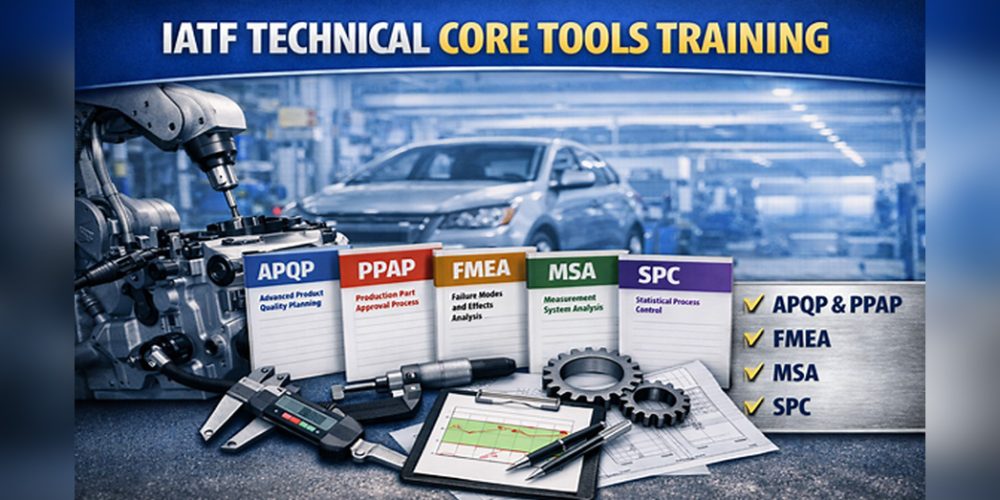
This program is designed to enable the participants to acquire the practical knowledge on the Interpretation of The Six Technical Core Tools of the AIAG-Reference Manuals with a view to integrate their applications into the IATF 16949:2016 Automotive QMS Requirements effectively.
Duration
4 days | 9am – 5pm | 28 hours
Who should attend
This program is designed for Quality Control / Quality Assurance / Technical and Engineering Personnel who are involved in managing IATF 16949 related Quality System activities with view to meet IATF 16949 Requirements.
Course Fees
Member Fee: S $1,805.04
Non-Member Fee: S $1,979.44
All fees stated are inclusive of Registration Fee and 9% GST.
Award of Certificate
Certificate of Completion will be issued to participants who have completed all class assignments and passed the exam. Certificate of Attendance for those attended at least 75% of the course.
Course Content
-
Day One (am): Advanced Product Quality Planning (APQP)
-
Introduction
-
Plan and Define Program
-
Product Design and Development
-
Process Design and Development
-
Product and Process Validation
-
Feedback, Assessment and Corrective Action
-
Class-room exercise and discussion
-
-
Day One (pm): Control Plan (CP)
-
Introduction
-
Control Plan Requirements and Guidelines
-
Control Plan Development
-
Control Plan Phases
-
Classroom exercise and discussion
-
-
Day Two: Failure Mode and Effect Analysis (FMEA)
-
Introduction o Purpose and Description o Objectives and Limits of FMEA o Integration of FMEA in the Company o FMEA for Products & Processes o Project Planning (5T) o FMEA Methodology
-
Execution of The Process FMEA (PFMEA) o 1st Step: Planning and Preparation o 2nd Step: Structure Analysis o 3rd Step: Function Analysis o 4th Step: Failure Analysis o 5th Step: Risk Analysis o 6th Step: Optimization o 7th Step: Results Documentation
-
Process Flow Diagram Analysis and Development of PFME
-
Classroom exercise and discussion
-
-
Day Three: Measurement System Analysis (MSA)
-
Introduction to: o MSA-GR&R Studies o Main Concept of Measurement System Analysis o Computation Techniques Associated with GR&R o Types of Measurement System Variation o Analysis of Measurement System Study (Ref: GR&R) o Variable Measurement Study (Range / Average Range / ANOVA) o Attribute Measurement System (Range / Ave. & Range / ANOVA) o Attribute Measurement System (Kappa Value & Effectiveness / Miss Rate / False Alarm Rate) o Method For reducing Unacceptable GR&R Result o Application of Calibration Techniques in Measurement System o Classroom assignment & exercise
-
-
Day Four (am): Statistical Process Control (SPC)
-
Introduction to the Essential SPC Tools o Measure of Dispersion o XBar-R Control Chart o Process Performance Studies: Pp. PpK o Process Capability Studies: Cp, CpK o Distinction and Interpretation of PpK & CpK Values
-
Application of the SPC Tools in managing the Key Production Processes
-
-
Day Four (pm): Production Part Approval Process (PPAP)
-
Brief Introduction to: o PPAP Process Requirements o Customer Notification and Submission Requirements o Submission to Customer – Levels of Evidence o Part Submission Status o Record Retention o Classroom exercise and discussion
-
Review and Discuss PPAP Requirements and their filings
-
Class-room assignment and discussion
-
Trainer